AI in manufacturing is often framed as a technology story. In this installment of The Humans in the Loop, we focus on people.
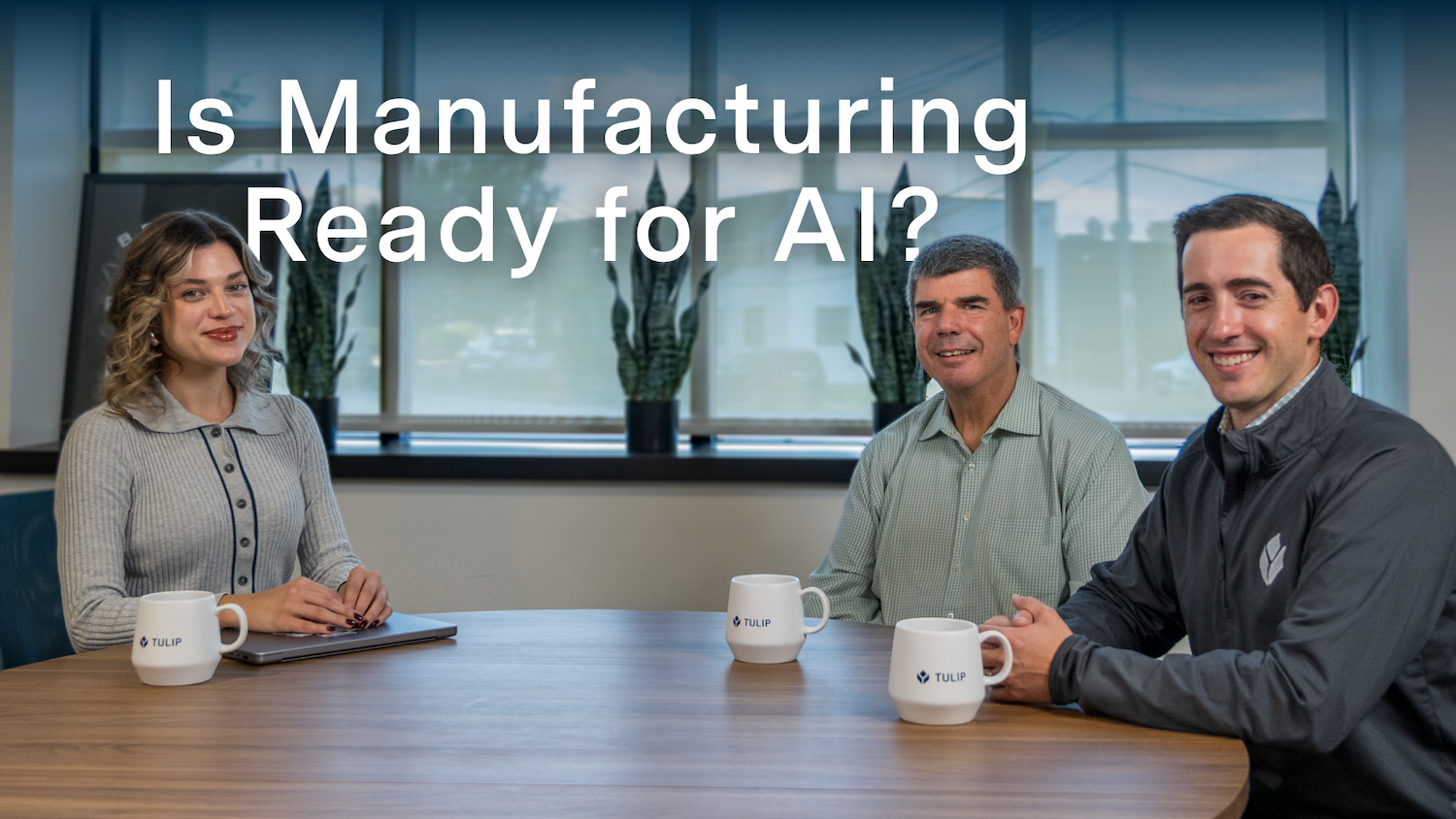
Over an extended conversation, Tulip CMO Madilynn Castillo sat down with Gilad Langer and Geoff Winkley to explore what it actually takes to bring AI into production environments. The result was a wide-ranging dialogue that touched on culture, data, design, and trust — the foundations that determine whether AI becomes another passing trend or a lasting capability.
The conversation unfolded naturally across three parts, each reflecting a stage of the same journey: assessing readiness, transforming data into wisdom, and rethinking how solutions are designed.
What ties these parts together is a shared belief that intelligence in manufacturing begins with people. AI can organize and accelerate knowledge, but it still depends on human context to make that knowledge useful.
The conversation begins with a question that has become increasingly urgent across factories worldwide: are manufacturers truly ready for AI?
Gilad describes readiness as something cultural before it is technical. For years, operational excellence and lean manufacturing have defined how plants improve. Those same principles, he explains, should guide how AI is adopted. Technology that fails to support those fundamentals, regardless of how advanced it appears, will not endure.
Geoff approaches the question from the floor-level view. Many manufacturers still struggle with basic visibility into performance. “How are we doing today?” remains difficult to answer in environments driven by paper, disconnected software, and fragmented data.
The group examines how hesitation, risk perception, and legacy systems can slow progress. Yet the deeper issue is confidence. Organizations want to know that new systems will improve their operations without disrupting what already works. This first part establishes a central theme for the rest of the discussion: AI readiness is measured through clarity of purpose and alignment with real operational needs.
The conversation next turns to data, the raw material of intelligence.
Manufacturers generate vast quantities of information, yet much of it remains scattered, inconsistent, or locked inside static documents. Gilad introduces the Data–Information–Knowledge–Wisdom (DIKW) framework to describe how modern AI tools can help compress these layers, connecting disparate sources and revealing relationships hidden within them.
Geoff brings this into practice. Drawing from his experience implementing solutions in aerospace and other industries, he explains how contextual models and language-based interfaces are helping teams organize human and machine data without heavy IT overhead. These systems bring order to complexity and provide insight that improves everyday decisions.
Both guests emphasize that AI should amplify understanding rather than automate judgment. The goal is to bring coherence to information that already exists within factories and to make that knowledge accessible to the people who rely on it.
The final part of the discussion focuses on design: how to build systems that make AI practical and safe for real operations.
Gilad outlines Tulip’s approach to solution design—creating composable, open, and adaptable systems that evolve alongside operations. He connects this philosophy to lean manufacturing and agile software development, disciplines grounded in iteration and feedback.
Geoff extends the conversation to the frontlines, describing how tools like Tulip’s AI Composer let engineers turn static documentation into live applications within minutes. Generative and agentic AI expand those capabilities, supporting automation where it creates value while keeping people involved in verification and improvement.
What emerges is a vision of manufacturing where technology adapts to people. Factories become environments of continuous learning, places where digital tools reflect how work actually happens and where AI helps teams respond faster to change.
Across these three parts, the conversation captures manufacturing at a pivotal moment. AI is moving from possibility to practice, becoming part of daily work rather than an isolated initiative. The challenge now is introducing it without losing the human expertise that defines effective operations.
For Tulip, that balance is the essence of being human in the loop. It means designing technology that understands context, reflects process knowledge, and keeps people accountable for the decisions that shape production.
Gilad and Geoff’s exchange reveals a quiet transformation taking place across the industry. The most successful manufacturers are beginning to treat AI as an environment—one that grows stronger each time people use it to understand, adapt, and improve.
Explore key questions raised by this conversation about AI in manufacturing
Q: How does generative AI apply to manufacturing operations?
Generative AI supports the creation and adaptation of digital work instructions, process documentation, and training materials. Instead of replacing human expertise, it scales it—helping engineers and operators digitize existing knowledge and continuously improve workflows without starting from scratch.
Q: What is agentic AI, and how is it different from traditional automation?
Agentic AI systems can take limited, contextual actions on behalf of users. Unlike traditional automation, which executes predefined steps, agentic systems evaluate information, propose changes, and learn from outcomes within defined boundaries. In manufacturing, this enables adaptive responses to process variation while maintaining human oversight.
Q: Why is contextual data important for AI in manufacturing?
AI is only as effective as the context it understands. In manufacturing, context includes machine status, operator inputs, environmental factors, and process history. Contextualized data allows AI systems to make relevant recommendations, connect insights across systems, and deliver guidance that reflects how production actually works.
Q: How does Tulip’s human-in-the-loop approach ensure AI safety and trust?
Tulip designs AI tools that keep people in control. Every recommendation or action from an AI feature is transparent, traceable, and auditable. By embedding human review into workflows, manufacturers can adopt AI with confidence—meeting compliance standards while accelerating improvement.
Q: What are the first practical steps to applying AI on the shop floor?
Start by identifying repetitive, knowledge-intensive processes that slow down operations—such as document management or issue resolution. Digitize those workflows and integrate AI tools that enhance visibility or automate data capture. Gradual, low-risk experimentation builds both technical capacity and trust across teams.
Q: How does AI change the role of engineers and operators in manufacturing?
AI elevates rather than replaces human roles. Engineers spend less time on repetitive modeling and more on creative problem-solving. Operators gain faster access to information, guidance, and insight. The result is a more connected, agile workforce that can focus on innovation and continuous improvement.
Q: What’s the difference between operational AI and enterprise AI?
Enterprise AI often focuses on business analytics or forecasting. Operational AI, by contrast, functions directly within production systems—helping people make better real-time decisions. It bridges the gap between data science and day-to-day work, embedding intelligence into the systems that run factories.