AI in manufacturing is often discussed in terms of capability — faster models, more automation, new interfaces layered onto old systems. In environments where production decisions affect quality, safety, and compliance, those conversations only scratch the surface. But beneath those conversations is a more fundamental question: how do people actually interact with intelligence in environments where context, safety, and accountability matter?
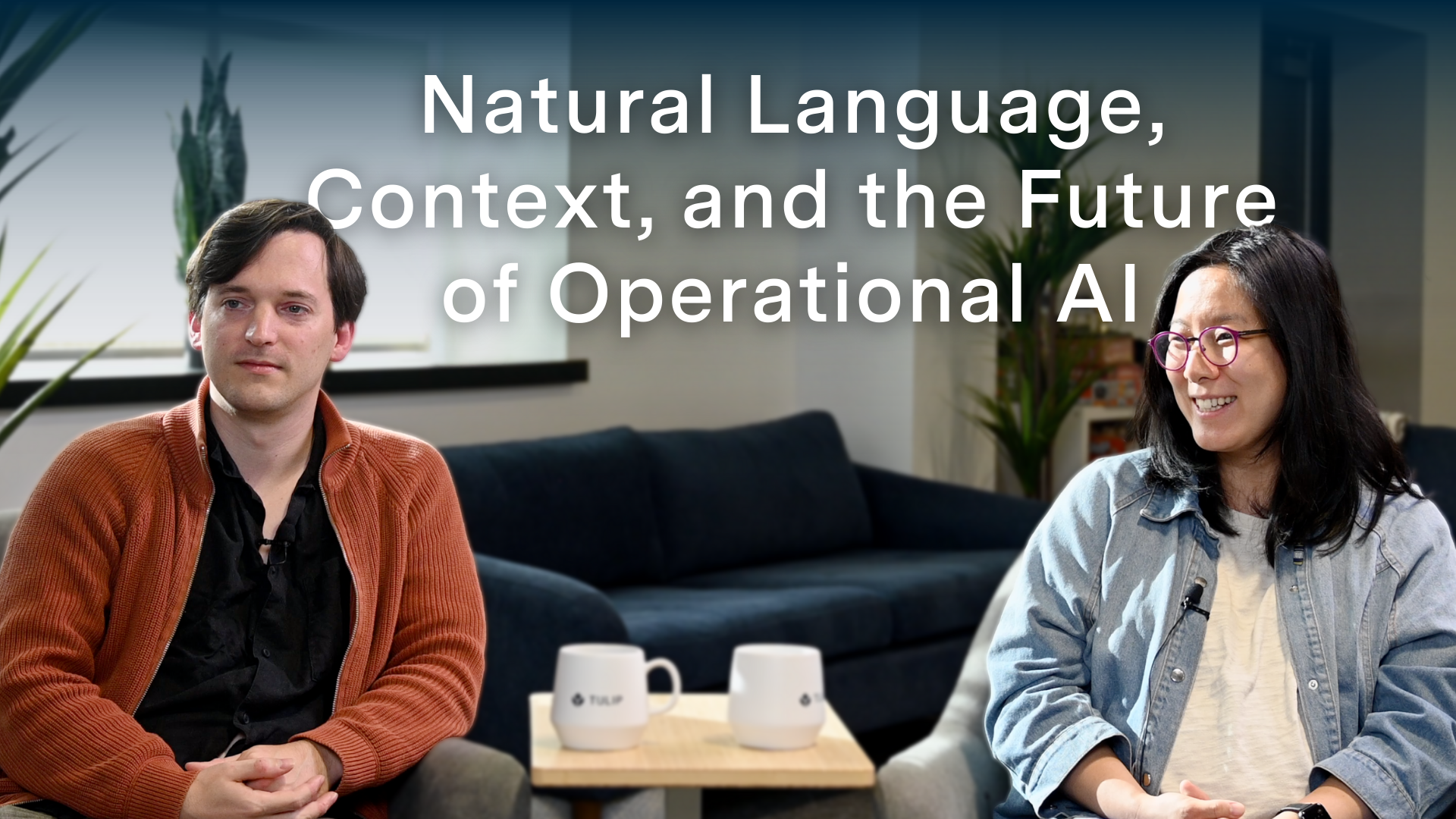
That question sits at the center of this episode of The Humans in the Loop. In a wide-ranging conversation, Tulip CMO Madilynn Castillo is joined by Nan and Robin to explore what it really takes to make AI useful on the frontline. Not as a standalone tool or a generic chatbot, but as part of the systems operators, engineers, and supervisors rely on every day. The discussion moves deliberately away from novelty and toward design — how AI fits into real workflows, how it earns trust, and how it supports human judgment rather than obscuring it.
What emerges is a clear point of view: the future of operational AI will be defined less by intelligence alone and more by interface. By whether people can understand what the system is doing, trace where information comes from, and adapt outputs to the realities of the shop floor. In manufacturing, usefulness depends on context, and context is something only people can ultimately provide. This conversation examines how AI can meet that bar — and why human-in-the-loop design is not a constraint on progress, but the condition that makes progress possible.
One of the strongest themes to emerge from the conversation is the role of natural language as an interface layer for manufacturing systems. For decades, interacting with production data has required specialized tools, rigid schemas, and expert mediation. Engineers model. Analysts query. Operators follow instructions generated elsewhere. The result is a constant translation effort between how work is done and how systems represent it.
Natural language changes that dynamic. Instead of forcing people to adapt to software abstractions, it allows systems to meet users where they already are — describing problems, asking questions, and sharing knowledge in the same way they do with one another. In manufacturing, this is not a cosmetic shift. It alters who can participate in problem-solving and how quickly insight can move from the floor to decision-makers.
That shift, however, only works when it is grounded in operational reality. Throughout the discussion, Nan and Robin emphasize that language must be tied to real data, real processes, and real constraints. Generic responses are insufficient in environments where precision, traceability, and accountability matter.
Seen this way, language is not an add-on feature. It functions as infrastructure — reducing friction, lowering the barrier to insight, and making intelligence accessible without diluting control.
As the conversation moves from interface to credibility, it becomes clear that natural language alone is not enough. In manufacturing, understanding must be accompanied by trust. People need to know not just what a system is telling them, but why it is telling them that, and whether the information can be verified.
Nan and Robin return repeatedly to the importance of traceability. In frontline environments, outputs must be inspectable and editable. Decisions often carry safety, quality, or compliance implications, and opaque recommendations create risk rather than value. This is why operational AI cannot behave like a black box.
Context plays a central role in making that possible. Manufacturing data is deeply situational. A value only matters in relation to the process step, the equipment state, the operator role, and the moment in time. By grounding AI responses in this operational context, systems can provide guidance that aligns with how work actually happens.
The conversation frames this approach as foundational rather than optional. Trust is not added after deployment. It is designed into the system through constraints, visibility, and human control. When AI reflects the structure and discipline of manufacturing itself, it earns a place in daily decision-making.
Trust, in turn, raises the question of control. As the discussion shifts, the idea of keeping a human in the loop takes on a more precise meaning. It is not presented as a safeguard layered on top of powerful systems, but as a core design requirement that shapes how those systems behave.
In manufacturing, decisions are rarely isolated. They ripple across quality, safety, throughput, and compliance. The people closest to the work carry contextual knowledge that no model can fully replicate. Operational AI must respect that reality by assisting, summarizing, and recommending, while leaving judgment and accountability with the people responsible for outcomes.
This perspective challenges a common narrative around autonomy. Progress is not measured by how much decision-making can be removed from humans, but by how effectively systems can support human reasoning. When AI invites review, correction, and iteration, it becomes a partner in improvement rather than a source of uncertainty.
Seen this way, human-in-the-loop design enables scale. By embedding review and intervention into everyday workflows, organizations can adopt AI more broadly without increasing risk. The result is more confident action grounded in both data and experience.
If control defines how AI behaves, productivity defines why it matters. As the conversation continues, productivity is reframed in quieter, more practical terms. The focus shifts from speed and automation to reducing cognitive load for the people doing the work.
Frontline teams spend significant time navigating between systems, interpreting documentation, translating information, and re-entering data. Much of this effort exists to compensate for the way tools are structured rather than the way work actually happens. The episode highlights how AI can absorb this overhead by handling repetitive interpretation tasks, allowing people to focus on judgment, problem-solving, and improvement.
Examples throughout the discussion point to this shift. Language translation removes friction on global production lines. Document processing turns static files into usable knowledge. Conversational access to analytics eliminates the need for specialized queries. Each capability reduces the mental effort required to move from question to action.
The significance of this change lies in how it reshapes roles. Engineers gain time to design and refine processes. Operators gain faster access to information that helps them respond in the moment. Supervisors spend less time assembling reports and more time understanding what is happening on the floor.
In this framing, AI becomes an infrastructure for clarity. By lowering the cognitive cost of interacting with systems, it makes improvement easier to sustain and easier to scale.
The conversation ultimately points to a broader shift underway in manufacturing software. AI is no longer treated as a collection of isolated features, added incrementally to existing systems. It is becoming part of the environment in which work happens.
When natural language, contextual data, and human oversight are designed together, intelligence stops feeling external to operations. It becomes embedded in workflows, decisions, and daily routines. People do not need to learn a new system in order to benefit from AI. The system adapts to how they already think, communicate, and act.
This shift has implications beyond individual use cases. Environments designed this way support continuous improvement by default. As people interact with systems, context deepens, data becomes more meaningful, and insight compounds over time. AI does not replace existing practices. It reinforces them by making learning and adjustment easier.
The discussion in this episode of The Humans in the Loop reflects a mature view of operational AI. Progress is measured by how naturally intelligence fits into the flow of work and how confidently people can rely on it. In manufacturing, that confidence comes from systems that respect context, preserve accountability, and keep humans at the center of decision-making.
Taken together, the ideas explored across this conversation suggest a future where AI fades into the background while its impact becomes more tangible. Intelligence is no longer something teams access occasionally. It is something they work with, every day, as part of the environment that supports how operations run and improve.
This conversation captures the spirit of The Humans in the Loop series at its core. It is not about showcasing technology for its own sake, but about examining how design choices shape the way people work with intelligence every day.
Across each part of the discussion, a consistent philosophy emerges. Useful AI in manufacturing starts with respect for context, discipline in design, and an understanding of human responsibility. Natural language, traceability, and human-in-the-loop systems are not trends. They are responses to the realities of frontline work, where decisions matter and accountability cannot be abstracted away.
By treating AI as part of the operational environment rather than a standalone tool, this approach aligns intelligence with the rhythms of real production. It allows manufacturers to adopt new capabilities without abandoning the principles that have long defined operational excellence.
In that sense, the future of operational AI looks less like a leap and more like a continuation. A continuation of designing systems that support people, make work clearer, and enable improvement to happen where it always has — on the front line, guided by human judgment and experience.
Human-in-the-loop means that people remain responsible for reviewing, validating, and acting on AI outputs. In manufacturing, this ensures decisions remain traceable, auditable, and aligned with safety, quality, and compliance requirements.
Natural language lowers the barrier between people and systems. It allows operators, engineers, and supervisors to interact with data and analytics without specialized tooling, making insight more accessible across roles.
Context determines relevance. Manufacturing data only has meaning when tied to process steps, equipment state, roles, and timing. AI systems grounded in operational context deliver guidance that reflects how work actually happens.
Traceability allows people to understand where information comes from and how conclusions are formed. This is essential in environments where decisions have downstream impacts on quality, safety, and regulatory compliance.
AI is best suited for repetitive, interpretation-heavy tasks such as translating languages, extracting information from documents, organizing data, and summarizing insights. This frees people to focus on judgment and problem-solving.
Operational AI is embedded directly into frontline workflows and supports real-time decision-making. Enterprise AI often focuses on analytics or forecasting at a business level rather than day-to-day execution.
Manufacturers can begin by identifying high-friction workflows, digitizing existing documentation, and introducing AI tools that enhance visibility and reduce manual effort. Starting small and iterating builds trust and capability over time.