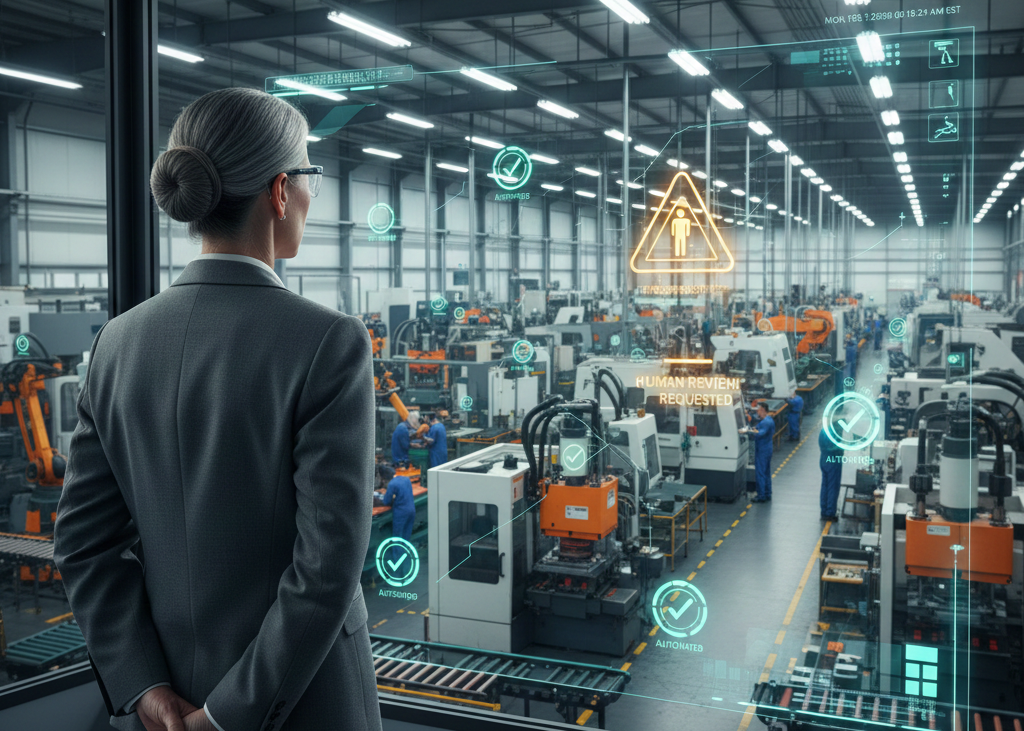
AI for Quality Management is the application of computer vision, generative AI, and machine learning to the entire quality ecosystem — automating visual inspections, streamlining root cause analysis (RCA), and predicting process drifts to shift quality from a reactive compliance task to a predictive operational advantage.
For decades, quality management has been defined by detection: catching bad parts before they leave the factory and logging the failure in a system. While necessary, this approach is expensive and reactive.
The next generation of quality is defined by prevention. By combining "The Eyes" (computer vision) with "The Brain" (generative AI), manufacturers can now spot trends that humans miss and automate the heavy administrative burden of compliance.
Most organizations treat their QMS (Quality Management System) as a digital filing cabinet. Non-Conformance Reports (NCMRs), CAPAs, and audit findings are entered into the system, but the data rarely comes back out to inform daily operations.
This creates a "Write-Only" memory. Valuable insights — like the fact that a specific machine always drifts out of spec on Tuesday mornings — are buried in unstructured text fields that traditional analytics tools cannot read. AI changes this by turning that static text into active intelligence.
To understand the landscape, we must distinguish between the two primary types of AI used in quality today:
1. Computer Vision ("The Eyes") This is the most visible form of AI. Using cameras and edge devices, systems can automatically detect scratches, missing components, or misaligned labels in real-time.
2. Generative AI ("The Brain") This is the emerging frontier. Generative AI doesn't just "see" defects; it understands the context. It can read thousands of historical batch records, summarize complex deviations, and suggest root causes based on data patterns that would take a human engineer weeks to correlate.
While computer vision captures defects after they are made, Predictive Quality aims to stop them from being created in the first place.
By analyzing streaming machine data (IoT) — such as spindle speed, heat, or pressure — AI models can detect subtle "process drifts" that a human would miss.
While computer vision catches the defect, generative AI solves the administrative nightmare that follows.
1. Automated Deviation Narratives In regulated industries like Pharma, a machine jam isn't just a jam — it's a paperwork event. Instead of an operator struggling to write a technical description, they can speak naturally: "The feeder jammed at Station 4 due to a bent pin." The AI converts this into a GxP-compliant deviation draft: "Equipment stoppage occurred at Station 4. Root cause identified as mechanical obstruction (bent pin). Maintenance notified." The Quality Engineer simply reviews and approves.
2. Interactive Root Cause Analysis (RCA)
Traditionally, RCA involves a team staring at a whiteboard. With AI, you can "chat" with your quality data.
3. Smart SOPs Operators often ignore 50-page PDF manuals. AI can ingest these documents and serve as an on-demand expert. An operator can ask, "What is the torque spec for the sub-assembly?" and get an instant, cited answer, ensuring Standard Work is actually followed.
One of the biggest limitations of traditional AI is that it operates in silos. A camera sees a defect, but it doesn't know why it happened.
Multimodal AI solves this by combining different types of data into a single analysis:
By synthesizing these three distinct signals, the AI can confidently suggest: "Scratches likely caused by torque spike due to material hardness variance in the new batch." This is a level of insight that isolated systems simply cannot provide.
A common misconception is that AI replaces systems like TrackWise, Veeva, or SAP QMS. It does not.
AI acts as the Intelligence Layer on top of these systems.
By integrating an Operations Platform with your QMS, you bridge the gap between the "Compliance Team" in the office and the reality on the shop floor.
For many manufacturers, the Cost of Poor Quality (COPQ) ranges from 5-15% of revenue. Much of this cost is buried in the "Hidden Factory" — the undocumented cycles of rework, re-testing, and scrap that occur to get an order out the door.
AI exposes this hidden cost by digitizing the "reasons" for rework.
In highly regulated sectors, the speed of quality determines the speed of revenue.
Sharp Packaging, a leader in clinical supply packaging, utilized digital workflows to streamline their operations. By moving away from paper and disconnecting legacy processes, they achieved a 30% reduction in process time.
When AI is added to this foundation — automating the "Review and Release" of Electronic Batch Records — the timeline for getting drugs to patients shrinks even further, without compromising patient safety.
The goal of AI in quality is not to remove the human, but to elevate them.
Especially in GxP environments, the "Human-in-the-Loop" is critical. AI suggests the root cause; the Quality Engineer confirms it. AI drafts the narrative; the Supervisor signs it. This approach allows manufacturers to harvest the speed of AI while maintaining the accountability required by auditors.
How is AI used in quality management? AI is used to automate visual inspections (computer vision) and streamline documentation (generative AI). It helps identify defects in real-time and assists in writing deviation reports, root cause analysis, and batch record reviews.
Does AI replace Quality Engineers? No. AI acts as a "Copilot" for quality engineers. It handles data analysis, drafting, and pattern recognition, allowing engineers to focus on complex decision-making and process improvement.
What is the difference between computer vision and generative AI in quality? Computer vision is used for physical inspection (detecting a scratch or missing part). Generative AI is used for analyzing text and data (summarizing defect trends, writing reports, or answering questions about SOPs).
Is AI safe for regulated (GxP) industries? Yes, provided a "Human-in-the-Loop" approach is used. AI should not make final release decisions. Instead, it prepares the data and recommendations for a qualified human to review and approve, maintaining full traceability and compliance.
Can AI help with Root Cause Analysis (RCA)? Yes. AI can analyze vast amounts of historical production data to find correlations that humans might miss (e.g., correlating a specific humidity level with a specific defect type), significantly speeding up the investigation process.