Manufacturing Orchestration is the digital layer that coordinates the interaction between people, machines, and AI agents. Unlike automation, which executes a single linear task (like a robot welding), orchestration manages the logic, timing, and data flow of the entire system, ensuring that the right resource gets the right information at the right time.
For the last 20 years, manufacturers have been obsessed with Optimization. We spent millions making individual machines faster, individual steps cheaper, and individual workers more efficient.
But optimization has a ceiling. You can make a robot weld 10% faster, but if the material hasn't arrived yet, that speed is worthless.
The bottleneck in modern operations isn't the execution of the task; it's the friction between the tasks. This is the Coordination Tax — the time and energy lost figuring out what to do next, who should do it, and where the materials are.
In 2026, the dominant model is shifting from Optimization to Orchestration.
Imagine a factory where every machine is running at 99% efficiency, but the forklift driver doesn't know which pallet to move next because the ERP data is 4 hours old.
That gap between system status and physical reality is the Coordination Tax.
Orchestration eliminates the tax by ensuring that decisions move with the work, rather than lagging behind it in a spreadsheet or a morning meeting.
If orchestration is so critical, why haven't we done it yet? Because our existing architectures—specifically the ISA-95 Pyramid—were designed for Accounting, not Action.
In a traditional "stack," data moves sequentially: Sensor -> PLC -> SCADA -> MES -> ERP.
To make a decision, a signal must travel all the way up to the ERP (business logic) and all the way back down to the shop floor. This creates Latency. By the time the ERP tells the scheduling software to re-route a job, the machine has already been down for 20 minutes.
This rigid, sequential structure creates massive IT/OT silos. For decades, the IT stack (business and supply chain logic) and the OT stack (machine and execution data) have operated in complete isolation. You cannot orchestrate a factory when the systems governing business priority and machine health cannot communicate in real time.
Furthermore, when manufacturers try to bridge these silos, they rely on rigid, point-to-point integrations (often called "Spaghetti Code").
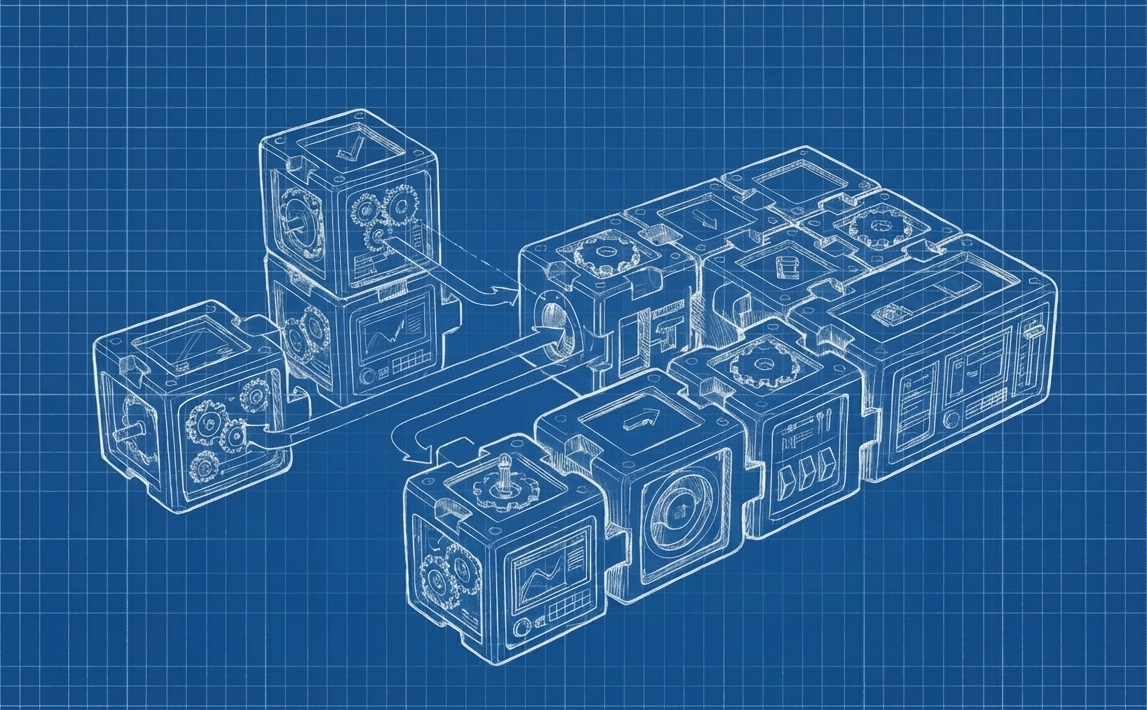
True orchestration requires a different architecture entirely: Composable, Event-Driven, and Decentralized.
Orchestration does not run on polling (asking "Are you done yet?" every second). It runs on Events.
In an orchestrated factory (typically powered by a Unified Namespace or UNS), every asset publishes its status to a central hub.
This is the difference between a Chain (where one broken link stops everything) and a Network (where traffic simply re-routes). If the Camera goes offline, the Orchestrator doesn't crash; it simply routes the Cycle_Complete event to a human inspector's tablet instead.
Historically, orchestration logic had to be hard-coded by engineers. You had to program every possible "If/Then" scenario.
This is brittle. Today, AI Agents are replacing these static scripts. Rather than acting as standalone chatbots, these agents operate as part of a broader system that manages how work flows across people, processes, and time horizons.
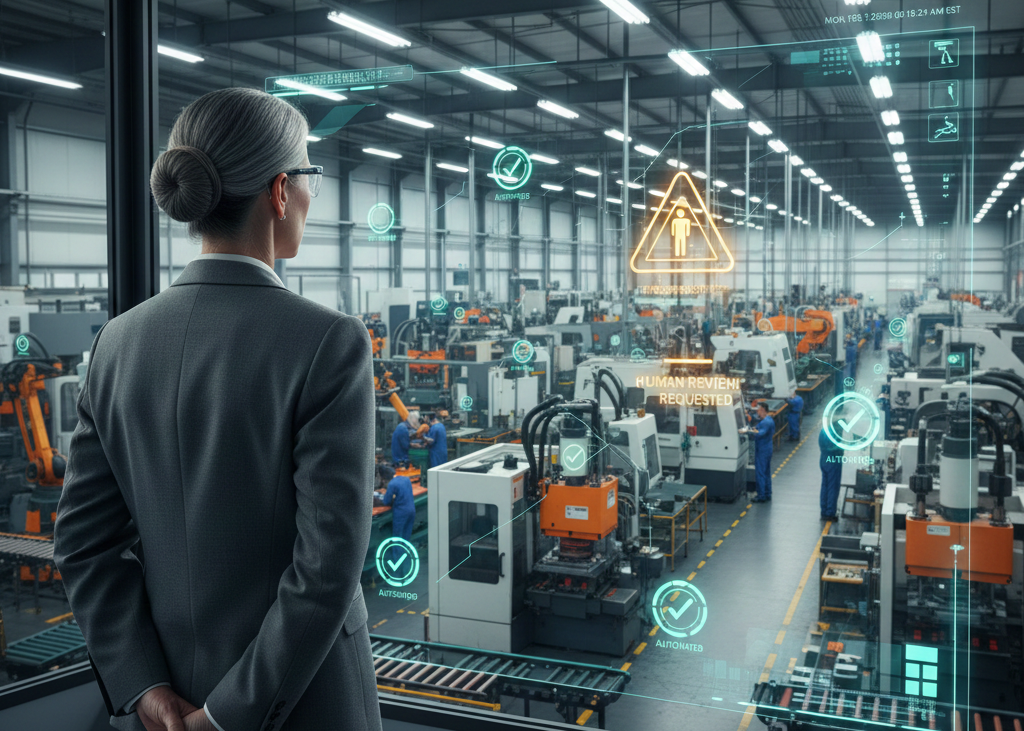
The goal of these agents is not to create a "lights-out" factory that replaces human judgment. Instead, true orchestration relies on a Human-in-the-Loop approach. The AI agents handle the high-speed "negotiation" between systems—processing the data, identifying the bottleneck, and proposing the optimal reroute—but they elevate the final decision to the frontline worker. By managing the rote coordination, the orchestration layer empowers humans to act as the ultimate supervisors of the process, applying their context and expertise where it adds the most value.
To understand the difference, let's look at how two factories handle a common event: A Bearing Seizure on Line 1.
Factory A (Optimization Model)
Factory B (Orchestration Model)
You cannot buy Orchestration in a box. It is an architectural approach built on three layers:
1. Connectivity (The Nervous System)
Before you can coordinate, you must connect. This requires moving away from proprietary protocols to open standards (like MQTT and Sparkplug B). Data must be liberated from the machine and published to a common broker where any app or agent can access it.
2. Logic (The Brain)
This is where the rules live. In the past, this was a static script. Now, it is a mix of deterministic logic (Triggers) and probabilistic logic (AI Agents). This layer decides: "Machine A is down, so route Order #123 to Line B."
3. Interface (The Hands)
Orchestration is useless if it doesn't reach the edge. The interface is how the system communicates with the human (via an App) or the machine (via an API). If the Orchestrator decides to reroute a job, the operator's tablet must update instantly to show the new instructions.
By 2026, manufacturers will judge AI maturity not by how smart a single chatbot is, but by how well their agents coordinate work without obscuring ownership.
True orchestration creates a factory where the system keeps pace with reality.
It transforms the factory from a collection of fast, disconnected islands into a single, synchronized organism.
What is the difference between automation and orchestration in manufacturing? Automation focuses on executing a single task efficiently, such as a robotic arm welding a part or a script entering data. Orchestration is the overarching layer that coordinates multiple systems, machines, and humans — ensuring that the robot, the material handler, and the scheduling system are all working in sync.
What is the coordination tax?
The coordination tax is the time, energy, and throughput lost to friction between value-added tasks. Even if individual machines run at 99% efficiency, the coordination tax — waiting for materials, searching for a supervisor, or manually updating an ERP — creates massive bottlenecks. Orchestration eliminates this tax by automating the flow of decisions.
Why can't my existing MES or ERP handle orchestration? Legacy manufacturing systems were built on a hierarchical, polling-based architecture (the ISA-95 model) using rigid, point-to-point integrations. This creates latency and brittle spaghetti code that breaks when processes change. True orchestration requires an event-driven architecture — like a Unified Namespace — where systems react to real-time events rather than static schedules.
How do AI agents fit into manufacturing orchestration?
Historically, orchestration required hard-coded logic (e.g., "If Machine A breaks, do exactly this"). Today, AI agents serve as a dynamic coordination layer. A maintenance agent and a scheduling agent can communicate in real time to reroute work during an unexpected equipment failure, allowing the system to adapt to physical reality instantly.
Does orchestration replace frontline workers?
No. Orchestration is designed to support the worker, not replace them. By handling the rote coordination tasks — like fetching data, updating tickets, and checking inventory — orchestration frees human workers from acting as biological routers, allowing them to focus entirely on high-value problem-solving and judgment.