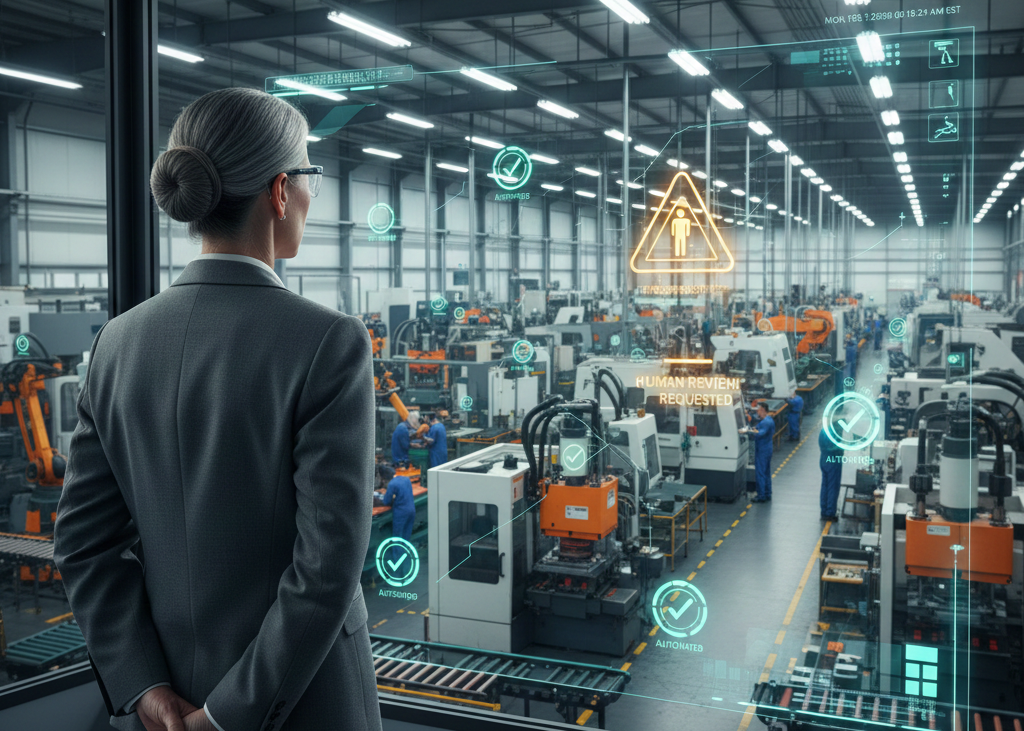
Human-in-the-Loop (HITL) in manufacturing is an operational model where AI systems and human workers collaborate on tasks. The AI processes data and provides recommendations, but a human expert retains the authority to verify, modify, or execute the final decision — ensuring safety, accountability, and nuance in complex production environments.
For the last decade, the implicit goal of manufacturing technology was to remove the human. The lights out factory was the north star, and human workers were often viewed as a source of variability to be engineered away.
In 2026, this logic is flipping. As AI agents and automation commoditize the routine work (data entry, scheduling, basic inspection), the value of the human worker is not disappearing — it is skyrocketing. But the nature of that value is changing.
We are moving away from using humans as bad robots — valuable only for their hands and eyes — and toward a model where Human Judgment is the primary output of the workforce.
Human-in-the-Loop (HITL) is the architecture that enables this shift. It is not a fallback for when the AI fails; it is the permanent operating system for a world where flexibility matters more than rote efficiency.
For too long, the industry has treated frontline workers as biological machines. We asked them to perform repetitive tasks, memorize complex SOPs, and manually bridge the gap between disconnected systems.
This was a waste of the one asset humans possess that AI lacks: Judgment.
HITL architectures allow us to stop using humans for the things AI is good at (the coordination tax of looking up data, scheduling, and logging) and focus them entirely on the high-leverage decisions that keep the factory running.
There is a paradox in engineering known as the Ironies of Automation (coined by Lisanne Bainbridge in her seminal 1983 paper). It states that the more advanced an automated system becomes, the more crucial the human operator becomes — not less.
Why? Because automation handles the routine, easy tasks efficiently. This clears away the noise, leaving only the complex, ambiguous, and high-risk edge cases for the human to solve.
If a factory relies entirely on autonomous AI, a raw material batch with slightly different chemical properties could cause the model to hallucinate and produce thousands of bad parts. A human in the loop spots the nuance ("This material feels waxy"), overrides the model, and adjusts the parameters based on physical intuition.
In this context, the human is not a bottleneck; they are the Critical Control Layer.
Not all HITL systems work the same way. Depending on the risk level of the process, the human's role shifts along a spectrum of control:
1. Human-in-the-Loop (The Gatekeeper) The AI provides a recommendation, but it cannot act until a human approves it.
2. Human-on-the-Loop (The Supervisor) The AI acts autonomously, but a human monitors the system and can intervene if parameters drift.
3. Human-out-of-the-Loop (Bounded Automation) The AI acts without human intervention.
Implementing HITL is not just a backend challenge; it is a User Interface (UI) challenge.
If you give an operator a black box that says "Reject this part" with no explanation, they will either blindly follow it (complacency) or ignore it entirely (distrust). To unlock human judgment, the interface must be Explainable.
Effective Connected Worker applications use Confidence Thresholds to govern the loop:
This turns the operator from a button pusher into an investigator. They aren't just executing a task; they are training the model. Every time they click Override, that data point is fed back into the system, making the AI smarter and the collaboration tighter.
1. Quality Assurance (The AI Spotter) Visual inspection is the classic HITL use case. Computer vision models are fast but prone to false positives. By using computer vision, the AI acts as a spotter, drawing a box around a potential defect.
2. Predictive Maintenance (The Sanity Check) An AI model might predict a 90% chance of bearing failure based on vibration data. However, shutting down the line is expensive.
3. On-Demand Frontline Intelligence We cannot expect new hires to memorize decades of tribal knowledge. AI assistants bridge the skills gap by making institutional knowledge conversationally accessible.
The manufacturing industry faces a persistent workforce crisis. With 3.8 million workers needed by 2033, and 1.9 million of those jobs potentially unfilled, the scarcity of skilled labor is the primary bottleneck for growth. We cannot hire our way out of this problem; we must augment our way out.
HITL AI serves as a force multiplier for manufacturing’s most limited resource: people.
By handling the cognitive load of data retrieval and routine monitoring, AI allows a single operator to manage more complexity without burnout. It also drastically shortens the learning curve. A new hire equipped with an AI spotter and intelligent assistant can perform at the level of a veteran much faster than traditional training methods allow.
This approach doesn't replace the worker; it scales their impact. It ensures that human ingenuity is applied only where it adds the most value — solving problems, improving processes, and making the critical decisions that machines cannot.
The factory of 2026 will not be empty. It will be busier than ever, but the work will look different.
We will see fewer people carrying clipboards and more people managing exceptions. We will see fewer people staring at parts for 8 hours and more people training agents to do it for them.
The manufacturers who win will not be the ones who automate the most; they will be the ones who figure out how to weave human judgment and machine intelligence into a single, seamless nervous system.
What is human-in-the-loop (HITL) in manufacturing? HITL is an operating model where humans oversee AI systems. The AI analyzes data and makes suggestions, but a human operator or engineer reviews those suggestions before final action is taken, ensuring safety and accuracy.
Why is HITL important for safety? AI models can make confident errors (hallucinations) when they encounter data they haven't seen before. A human in the loop acts as a safety valve, catching these errors before they result in injury, scrapped product, or equipment damage.
Does HITL slow down production? Not necessarily. While it adds a verification step, it prevents the massive downtime associated with AI errors. Furthermore, human-on-the-loop systems allow one human to supervise many AI agents, vastly increasing overall throughput compared to manual work.
What are the "Ironies of Automation"? The "Ironies of Automation" is a concept (coined by Lisanne Bainbridge) stating that as automated systems become more advanced, the human operator becomes more important, not less, because they are needed to handle the complex, unforeseen "edge cases" that the automation cannot resolve.
Is HITL required for GxP? In many cases, yes. Regulations like FDA 21 CFR Part 11 place heavy emphasis on data integrity and accountability. While AI can process data, a human identity is often required to sign off on critical decisions like batch release.