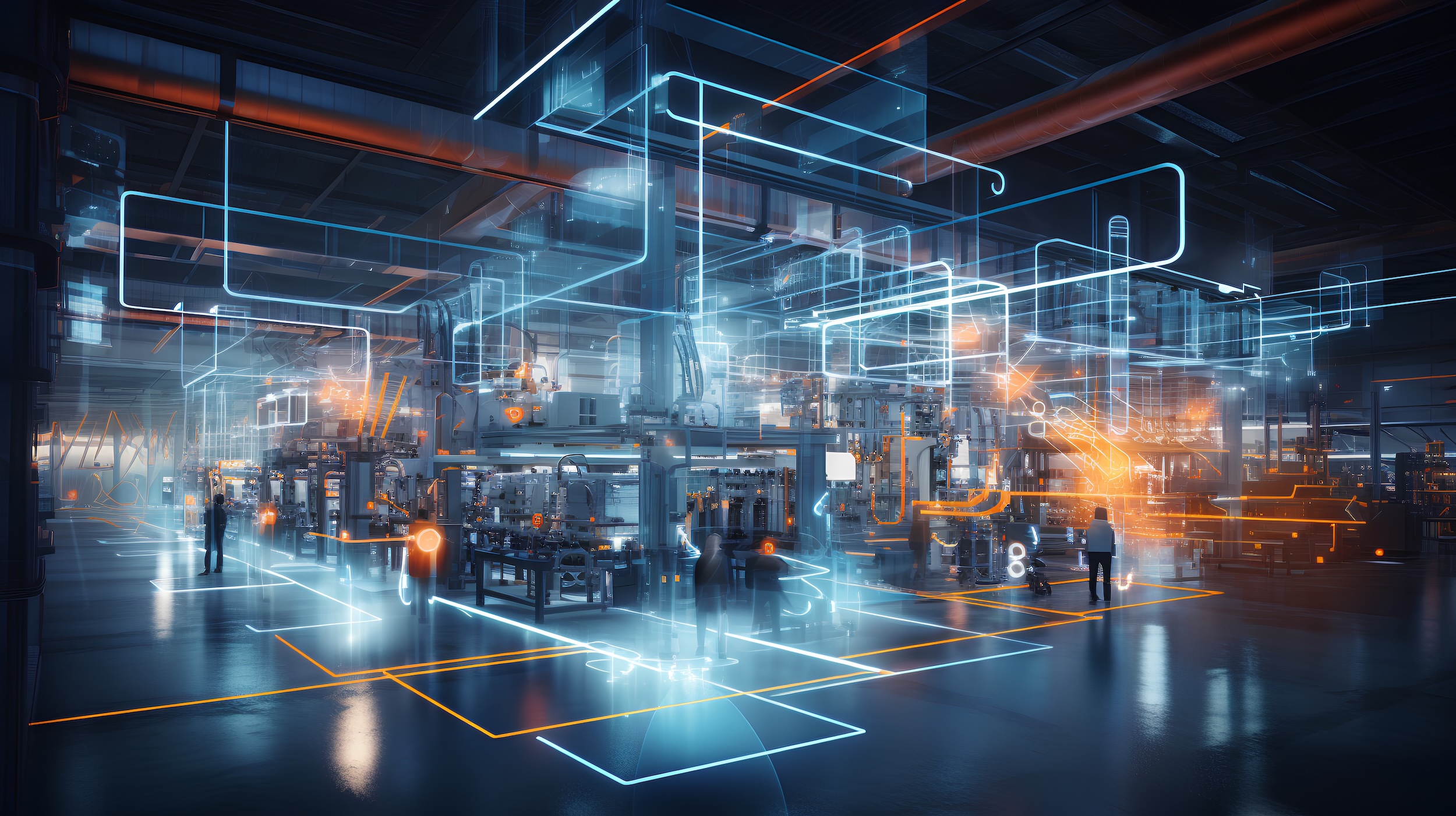
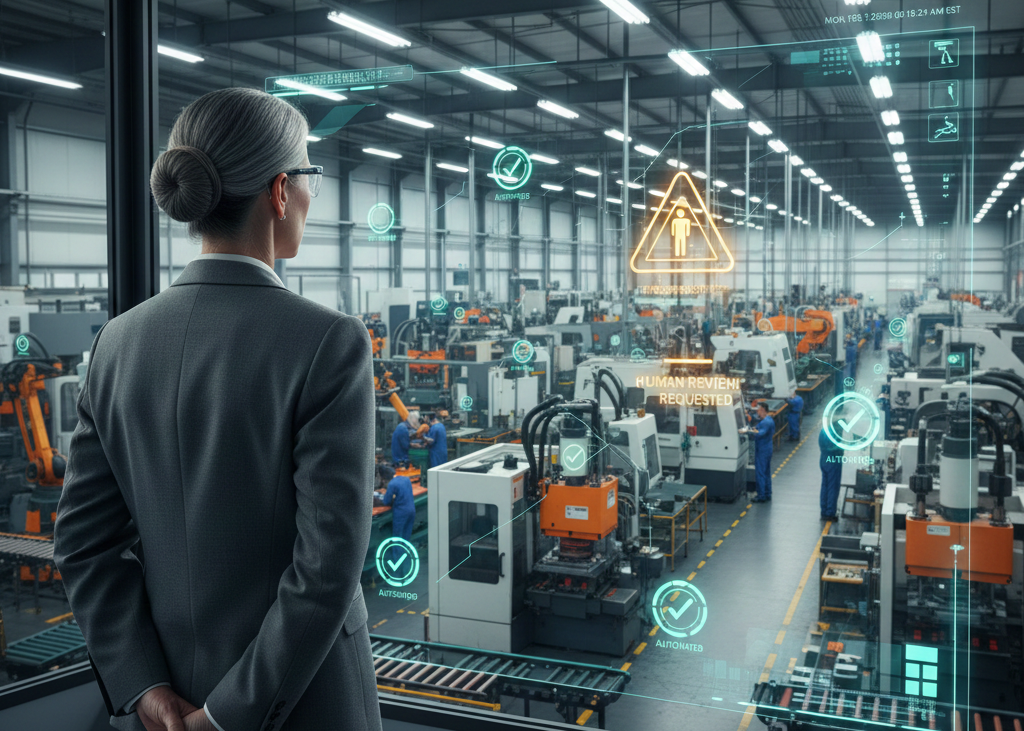
Manufacturing Data Readiness is the state where operational data is not just accurate, but contextualized—meaning every data point (e.g., temperature) is automatically tagged with its surrounding reality (Worker ID, Work Order, Machine State) at the moment of creation, making it immediately consumable by AI models without manual cleaning.
For years, manufacturers were told that to get ready for AI, they needed "Big Data." So, they spent millions building Data Lakes, dumping terabytes of sensor readings into the cloud.
Today, most of those lakes are actually "Data Swamps." The data is there, but it is unusable. Why? Because a vibration reading of 0.54 mm/s means nothing to an AI unless it knows what product was running, who was operating the machine, and if the machine was supposed to be idle.
Data readiness is not about volume. It is about Context. Without it, your AI strategy will stall at the pilot phase.
In the consumer world, data is naturally contextualized. A credit card transaction carries a User, Vendor, Timestamp, and Location embedded in the file.
In manufacturing, data is fragmented across the ISA-95 stack:
To an AI model, these are three unrelated languages. This is the "Context Gap."
When you feed an AI raw, disconnected data, you introduce "Ambiguity Risk."
If an operator asks an AI Assistant, "Why did Line 1 stop?", and the AI only sees a Motor_Amps: 0 signal, it might hallucinate a mechanical failure.
However, if that data point was contextualized with a State: Planned_Changeover tag, the AI correctly identifies the event as a standard procedure. Context is the difference between a helpful insight and a dangerous lie.
To move from a "Swamp" to a strategy, your data architecture must solve for three specific layers:
1. Structure (The Semantic Schema)
Legacy systems use obscure tags like PLC_Tag_101 or Register_4002. This requires a human to manually map every point.
AI-Ready data uses a Semantic Model (e.g., Site/Area/Line/Oven_1/Temperature). This ensures that when an AI looks for "Oven Temperature," it finds it across every site instantly, regardless of whether the oven is made by Siemens or Allen-Bradley.
2. Context (The Metadata)
This is the most critical missing link. Machine data must be enriched with human context.
3. Access (The Protocol)
Traditional point-to-point integrations (SQL queries, API calls) are too rigid for AI. They create tight dependencies.
AI requires a Pub/Sub architecture (like MQTT/Sparkplug), where data is published to a central broker. This allows an AI agent to simply "subscribe" to a data stream without needing a custom integration built by IT.
The architectural solution to the Context Gap is the Unified Namespace (UNS).
Think of the UNS as a "Central Nervous System" for your factory. Instead of connecting every app to every machine (a messy "spaghetti" architecture), all systems publish their data to a central hub, organized by a clear hierarchy.
Line1/Oven/Temp: 400Line1/Oven/Status: ActiveLine1/Oven/# and instantly sees both.By implementing a UNS, you ensure that context is applied in real-time, making your data "AI-Ready" the millisecond it is generated. This enables RAG (Retrieval Augmented Generation) patterns where the AI can query the current state of the factory to answer live questions.
Most "Data Readiness" initiatives focus solely on machine sensors. This is a fatal flaw. Sensors can tell you what happened, but they rarely tell you why.
If you exclude this human insight from your dataset, your AI will never learn causality. Using No-Code Apps to capture operator logs, observations, and actions is essential for training AI models that understand the full reality of production.
A common objection is: "My machines are 30 years old; they don't have APIs."
You do not need to replace legacy equipment to make it AI-Ready. You need to wrap it.
To visualize the difference, look at how an AI "reads" a data packet.
If you want to prepare your facility for Frontline Intelligence, start here:
What is the biggest barrier to AI in manufacturing?
The biggest barrier is lack of context. Most factories have plenty of data, but it is siloed in different systems (PLC, ERP, MES) without a common structure, making it impossible for AI to correlate cause and effect.
Do I need a Data Lake for AI?
Not necessarily. While Data Lakes are good for long-term storage, AI requires real-time, structured data. A Unified Namespace (UNS) is often more effective for enabling live AI agents than a static Data Lake.
What is a Unified Namespace (UNS)?
A Unified Namespace is an architectural approach where all data from machines, apps, and sensors is published to a central location using a common hierarchy. It acts as a single source of truth that AI systems can easily access.
Why is human data important for AI?
Sensors only capture the physical state of a machine. Human data (captured via apps) provides the context—the "why" something happened (e.g., "maintenance delay," "bad material"). AI needs this context to learn effectively.
How do I handle legacy (Brownfield) machines?
You don't need to replace them. Use IoT gateways to extract data, or use apps and cameras to "wrap" the machine in a digital layer, allowing you to capture data without upgrading the core controls.