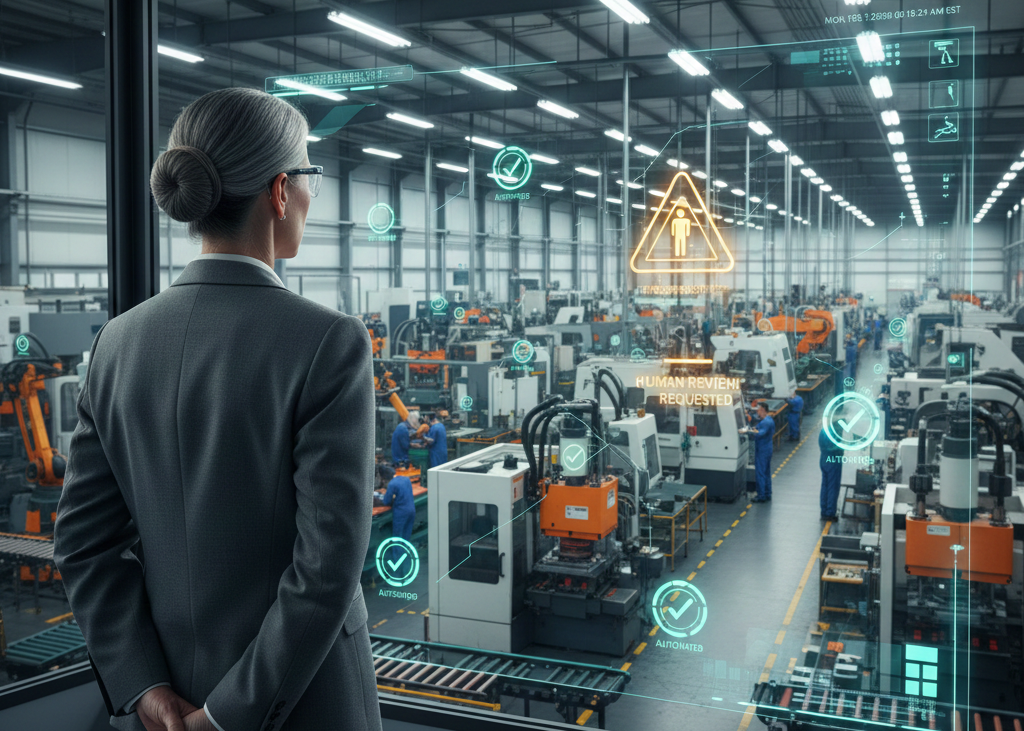
Manufacturing is in a moment where information moves faster than people can process it. Teams manage volumes of documents, specifications, SOPs, work instructions, logbooks, audits, and daily production updates — all while keeping lines running, training new operators, and responding to constant change on the floor.
Generative AI matters now because it reduces the friction created by these knowledge-heavy tasks. Instead of digging through PDFs, searching shared drives, or relying on tribal knowledge, teams can ask direct questions and receive clearer, contextual answers in seconds. This shift doesn’t replace expertise — it gives people faster access to it.
Workforces are also changing. High turnover, shorter training cycles, and global operations mean manufacturers need tools that help operators get up to speed quickly and execute tasks consistently. Generative AI provides real-time support that scales: explaining procedures, summarizing documents, translating instructions, and offering guidance at the moment it’s needed.
Finally, manufacturers are under pressure to digitize — and much of that work starts with documents. Generative AI accelerates this transformation by helping teams turn SOPs, manuals, and legacy records into structured, usable digital content. It bridges the gap between unstructured knowledge and frontline execution, making it a practical entry point for AI adoption on the factory floor.
Generative AI excels at helping manufacturers interpret information, transform documents, and provide clear explanations when teams need them most. Its strength is language — extracting meaning from unstructured content and generating responses that help people work faster and more accurately.
Generative AI can take dense manuals, SOPs, work instructions, engineering documents, or quality records and turn them into usable insights. It summarizes, restructures, and explains information in simpler terms, enabling teams to understand complex content without searching through multiple sources.
Instead of relying on tribal knowledge or digging through documentation, teams can ask direct questions — about procedures, troubleshooting, part requirements, or process steps — and receive answers grounded in the relevant documents.
From operator notes to audit logs to test results, manufacturing produces information that isn’t always structured for easy use. Generative AI can convert this into summaries, bullet points, or structured content suitable for quality reviews or daily standups.
Generative AI is not an execution engine. It does not make decisions or trigger actions on the shop floor. Those responsibilities fall under predictive or agentic AI, where context, governance, and defined autonomy are required.
Generative models also cannot reason about processes or machine states without the necessary context. Without guardrails, they can misinterpret instructions or hallucinate missing information — which is why manufacturing requires strong oversight and validation.
Manufacturing processes follow strict procedures and depend on accurate sequencing, operator qualifications, material readiness, and equipment conditions. Generative AI needs this context to provide safe and relevant answers. When embedded inside governed workflows — such as those built in Tulip — these systems become more reliable because the model is guided by real operational data, permissions, and rules that constrain its behavior.
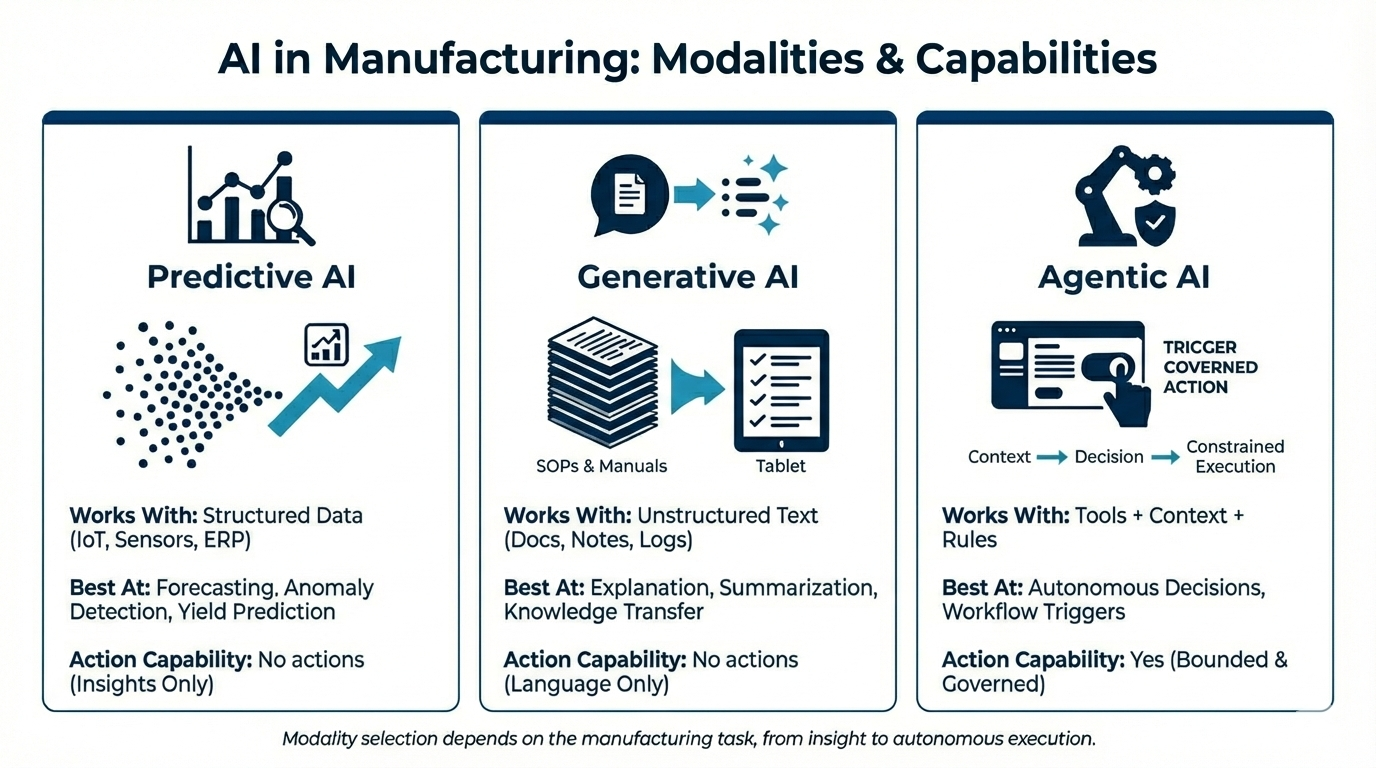
Manufacturing teams often hear these three terms used interchangeably, but each type of AI serves a different purpose — and understanding the differences is essential for choosing the right tools.
Predictive AI analyzes historical and real-time data to identify trends, detect anomalies, and forecast outcomes. It excels at questions like:
Predictive models are context-specific and rely heavily on the quality of the underlying data. They support decision-making but don’t generate instructions, explanations, or language-based outputs.
Generative AI works with unstructured information — documents, notes, instructions, logs — and produces human-readable output. It is best suited for:
Its strength is interpretation and explanation, not action.
Agentic AI combines reasoning with tool execution. Agents can:
In manufacturing, agentic AI must operate within strict governance. Autonomy levels, permissions, and HITL/HOTL oversight determine what it can and cannot do.
Here’s a simple way to think about the distinction:
Generative AI is most powerful when it’s applied to the knowledge-heavy, documentation-driven, and interpretation-focused work that slows teams down. These use cases reflect where manufacturers see the greatest returns today — not hypothetical future applications, but practical improvements happening on real production floors.
Manufacturers often have decades of SOPs, manuals, and batch records stored as PDFs or static documents. Generative AI can interpret these files and turn them into structured, step-by-step instructions that are easier to follow and update.
In Tulip, AI Composer accelerates this process dramatically — teams report up to an 80% reduction in the time required to build digital work instructions.
Operators frequently need quick answers: “What’s the torque specification?”, “Which test comes next?”, “Why is this alarm firing?”
With generative AI copilots, they can chat with manuals, SOPs, quality procedures, and even sensor or equipment data. This reduces downtime and speeds troubleshooting.
One manufacturer, Outset Medical, saw a 50% reduction in defect resolution time using this pattern.
Global manufacturers rely on consistent workflows across regions. Translating apps and instructions manually is slow and error-prone.
Generative AI can automatically translate digital work instructions, labels, and procedures into dozens of languages. Tulip customers have used this capability at scale — for example, DMG MORI translated over 1,400 apps using AI-assisted translation patterns.
Quality teams spend significant time writing, reviewing, and organizing documentation. Generative AI helps by:
This reduces administrative load and helps teams focus on higher-value work.
Daily production summaries, standup reports, and shift handoffs require teams to synthesize large amounts of information quickly. Generative AI can automatically:
This ensures everyone starts each shift with a clear picture of what happened and what needs attention.
Inspection, labeling, and verification tasks often depend on reading serial numbers, checking labels, or capturing visual defects. Generative AI working alongside vision systems can:
This speeds up documentation and reduces human error.
New operators face steep learning curves. Generative AI supports onboarding by:
This helps teams ramp up faster and reduces dependency on tribal knowledge.
Generative AI delivers value when it helps teams work faster, make better decisions, and reduce the friction created by documentation and communication bottlenecks. These benefits show up across training, quality, engineering, and daily operations.
Manufacturers often struggle to convert years of legacy documents into usable digital formats. Generative AI accelerates this shift by:
This shortens digitization timelines and frees engineers and quality teams to focus on higher‑value improvements.
Operators gain immediate access to the knowledge they need — without searching through shared drives or relying on experienced colleagues. Generative AI helps:
This leads to more consistent execution and fewer pauses on the line.
When teams no longer lose time searching for answers or rewriting documents, throughput improves. Generative AI helps shorten:
Even small time savings compound across shifts and sites.
Generative AI introduces conversational interfaces that make it easier for operators to get help in the moment. When embedded directly into apps and workflows, AI becomes a natural extension of the tools teams already use.
This reduces cognitive load and supports a more intuitive, responsive production environment.
Generative AI can drive meaningful improvements in manufacturing, but only when deployed with the right safeguards. Production environments — especially regulated ones — require predictability, traceability, and human oversight. Without guardrails, even small model errors can introduce quality or compliance risks.
Manufacturers work with sensitive information: formulations, device designs, process parameters, and proprietary methods. Sending this data to unmanaged, public models creates unacceptable exposure.
Modern platforms avoid this risk through model isolation, secure data boundaries, and strict permission controls.
Generative models can produce plausible but incorrect answers. In manufacturing, a wrong parameter, misstated instruction, or misinterpreted requirement can create deviations or safety risks.
HITL (human-in-the-loop) review and supervised usage remain essential.
In FDA- and EMA-regulated industries, any AI-generated content used in production must be reviewed, validated, or incorporated through governed release processes. This includes:
Generative AI can accelerate these tasks, but it cannot bypass compliance obligations.
Generative AI should draft, summarize, or assist — not execute. Human review ensures:
This protects both operators and product integrity.
With the right governance, generative AI becomes a reliable assistant rather than a risk. Without it, even simple tasks can introduce variability or noncompliance.
Generative AI is most effective when it’s embedded directly into the systems, data flows, and governed workflows that manufacturers already rely on. Instead of operating as a standalone chatbot or bolt‑on application, it becomes part of the production environment — drawing on real context and supporting real work.
Generative AI delivers the most value when it’s built into frontline applications rather than living in a separate interface. This allows operators to:
Embedding AI reduces context switching and ensures answers are grounded in the process being executed.
Generative AI becomes far more reliable when it can use structured manufacturing data — machine states, operator inputs, material information, and historical context — to guide responses.
A unified data layer ensures:
This reduces the risk of hallucinations and makes AI support more trustworthy.
Modern manufacturing platforms use APIs and the Model Context Protocol (MCP) to safely connect AI to tools, data, and actions.
With MCP:
This enables generative AI to support more advanced workflows — like generating instructions, drafting summaries, or preparing action recommendations — without bypassing governance or safety constraints.
Together, these architectural components allow generative AI to operate as a reliable assistant inside the factory, not an external system working with incomplete information.
Generative AI delivers the most impact when manufacturers start with focused, high‑leverage workflows. These early wins build confidence, strengthen governance practices, and lay the groundwork for more advanced AI adoption.
Processes that depend on manuals, SOPs, batch records, or engineering documentation are ideal first candidates. Generative AI can:
This accelerates digitization without requiring major system changes.
Operator questions slow down production when answers aren’t easy to find. Copilots help teams:
This reduces downtime and builds operator confidence.
Generative AI simplifies deployment across regions by translating:
This reduces rollout time and ensures consistency across sites.
Quality teams can shorten review cycles by using AI to:
This reduces administrative workload and speeds investigations.
Before scaling generative AI, manufacturers should define:
Strong governance ensures AI outputs remain accurate, compliant, and safe.
Generative AI is most effective early on, but its value compounds when paired with agentic capabilities. As data and governance structures solidify, manufacturers can introduce AI systems that:
This creates a pathway toward more autonomous, yet controlled, AI‑supported operations.
Generative AI in manufacturing refers to AI systems that interpret, summarize, translate, or generate content from documents, logs, notes, and unstructured information. It supports operators and engineers by providing clearer, faster access to knowledge.
Common applications include turning SOPs into work instructions, answering operator questions, summarizing shift notes, translating apps, drafting quality documentation, and supporting inspections with OCR and text extraction.
Predictive AI identifies trends and forecasts from structured data. Generative AI interprets and produces language. Agentic AI can take action with guardrails. Most manufacturers use all three together inside governed workflows.
Yes — when outputs are reviewed by humans, tied to validated documents, and constrained by clear governance. HITL oversight ensures content is accurate and appropriate for the process.
Manufacturers need data boundaries, permission controls, HITL/HOTL checkpoints, and validation steps for any AI-generated content used in production.
Keep generative AI grounded in validated documents, governed data sources, and workflow context. Require human review for any critical output.
Not typically. The model reads from validated content rather than learning from production data. Governance focuses on review and approval, not model retraining.
Through API-first and MCP-based architectures that restrict access, validate data pathways, and ensure AI operates within approved, auditable boundaries.