Every operations manager knows the golden rule of the shop floor: The 6:00 AM production schedule is completely obsolete by 6:15 AM.
For decades, production scheduling has been treated as a math problem to be solved in a vacuum. Planners take demand from the ERP, run it through scheduling software, print out a Gantt chart, and hand it to the floor. But the moment a machine jams, a material shipment is delayed, or a key operator calls in sick, that perfect mathematical plan shatters.
AI Production Scheduling is changing this paradigm. It shifts scheduling from a static, batch-processed guess into a living, event-driven process. Rather than simply generating a plan for a perfect world, AI continuously recalculates and proposes dynamic adjustments based on the real-time constraints of the physical factory.
Here is how AI is moving manufacturing from static planning to dynamic reality—and why the master scheduler’s job is about to become much more strategic.
Most factories rely on Advanced Planning and Scheduling (APS) software or massively complex Excel spreadsheets to sequence their work. These legacy systems have a "glass jaw" — they look highly sophisticated, but they break on first impact with reality.
Traditional APS systems fail in modern environments for three reasons:
In a high-mix, high-volatility manufacturing environment, scheduling cannot be a daily event. It must be a continuous capability.
AI production scheduling does not just speed up the math; it changes the underlying architecture of how work is sequenced. It introduces three critical capabilities:
1. Real-Time Constraint Awareness Traditional systems schedule blindly. AI scheduling connects directly to the edge (via sensors, PLCs, and connected worker apps). It knows that Line 2 is currently running 15% slower than usual because of a worn tool, and it actively avoids routing a high-tolerance, time-sensitive batch to that machine until maintenance is complete.
2. Scenario Simulation (The "What-If" Engine) When a disruption occurs, AI can run thousands of permutations in seconds. If an oven goes down, the AI instantly simulates the ripple effects: If we move Order X to Oven B, will it cause a bottleneck at the packaging station? Will it force us to miss the shipping window for Order Y?
3. Agentic Rerouting Tying into the broader concept of Manufacturing Orchestration, AI scheduling relies on autonomous agents. A Scheduling Agent doesn't just shuffle a spreadsheet; it communicates with the Maintenance Agent and the Inventory Agent to ensure that a proposed schedule change is actually physically possible before presenting it to a human.
A common misconception is that AI scheduling is designed to replace the Master Scheduler and create a "lights-out" planning department. This is entirely false.
The goal of AI scheduling is to eliminate the "Coordination Tax" — the hours schedulers spend chasing down status updates, erasing whiteboards, and manually fighting fires.
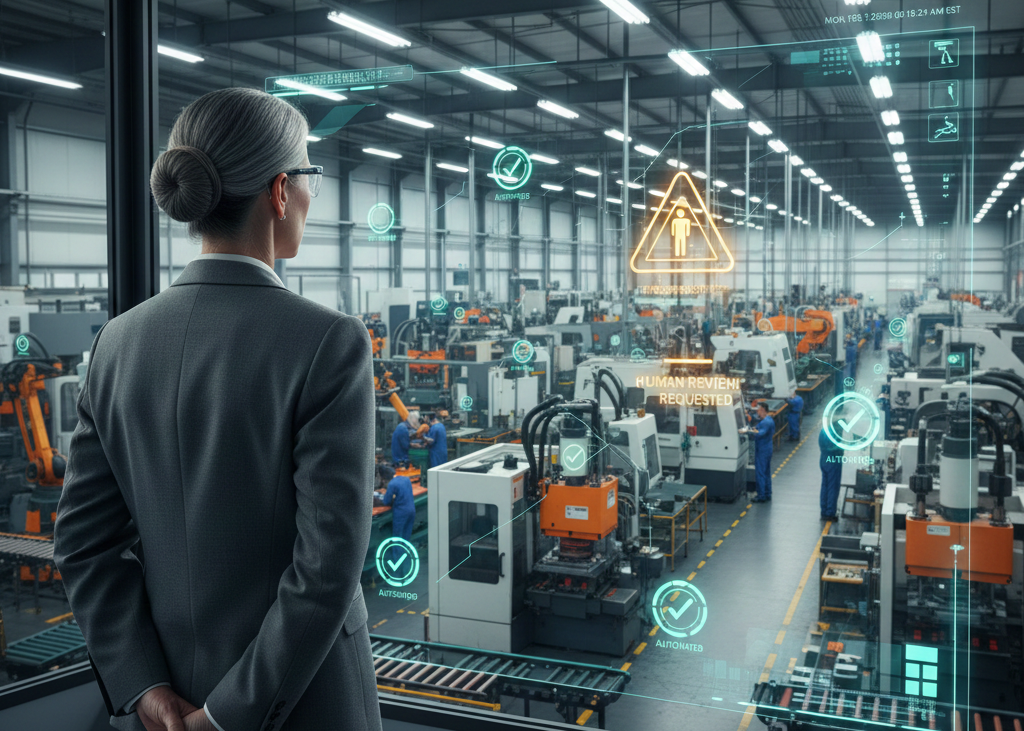
In an AI-driven environment, the system acts as a highly capable Copilot. When a disruption happens, the AI instantly calculates the three best recovery paths and presents them to the scheduler.
The AI proposes; the human decides. Operating within a Human-in-the-Loop framework, the Master Scheduler applies the nuanced business context that the AI lacks (e.g., "Option B is best because we promised the CEO of that client a favor"). The human role is elevated from a data-entry clerk to a strategic pilot.
To understand the value, look at how an AI-driven factory handles the classic "Hot Order" scenario.
Sales just dropped a massive, unexpected, high-priority order that must ship by Friday.
You cannot buy an AI scheduler and drop it on top of a clipboard-and-whiteboard operation. AI requires a foundation of operational data.
To enable dynamic scheduling, manufacturers must first build:
The era of the static morning schedule is ending. Manufacturers can no longer afford the latency between a disruption occurring and the schedule adapting. By leveraging AI to create a living, event-driven orchestration layer, factories can finally build schedules that survive the reality of the shop floor — ensuring that the right work gets done by the right resource, at the exact right time.
What is AI production scheduling? AI production scheduling uses real-time data, machine learning, and autonomous agents to dynamically sequence manufacturing operations. Unlike traditional systems that generate static plans based on historical averages, AI continuously recalculates the optimal flow of work based on current machine health, material availability, and worker constraints.
How does AI scheduling differ from legacy APS software? Legacy Advanced Planning and Scheduling (APS) software often relies on batch-processed data from an ERP, meaning it cannot react to real-time disruptions. AI scheduling is event-driven; it connects directly to edge devices and instantly simulates recovery scenarios the moment a disruption (like a machine failure) occurs.
Will AI replace production schedulers? No. AI acts as a copilot to eliminate the manual, administrative burden of recalculating schedules during a crisis. It proposes optimized recovery paths, but the human Master Scheduler retains final approval, applying crucial business context and judgment to the AI's recommendations.
What data is required to implement AI scheduling? AI scheduling requires a robust data foundation, including real-time edge connectivity (sensor and machine data), accurate digital twins of routings and Bills of Material (BOMs), and a unified data architecture that breaks down the silos between IT (ERP) and OT (shop floor) systems.