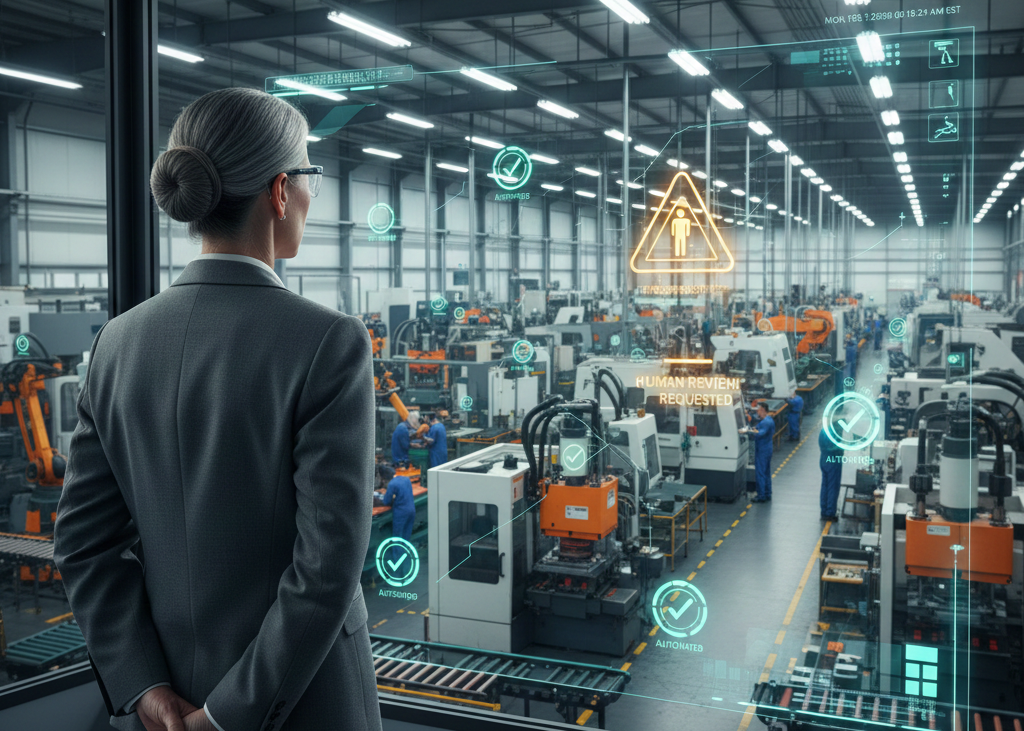
Manufacturers are under increasing pressure to improve productivity and reliability while managing more complexity, variability, and skill gaps than ever. Even with predictive models, dashboards, and alerts, most organizations still struggle to translate insights into action. This insight-to-action gap limits the impact of AI in manufacturing and has become a defining barrier to operational performance.
Predictive systems reveal what’s likely to happen but rely on humans to interpret signals and coordinate responses. Generative AI helps interpret data faster, but execution still depends on people navigating fragmented systems. Agentic AI adds what traditional manufacturing AI has lacked: the ability for systems to read context, plan next steps, and support execution within defined boundaries.
Engineers and frontline teams routinely move between dashboards, emails, work orders, and logs just to close a single issue. Quality teams triage deviations across disconnected tools. Maintenance receives alerts without full context. Every handoff adds delay and variation.
Manufacturers don’t lack data—they lack a reliable mechanism to turn AI insights into timely, governed action.
Production environments shift constantly: product mixes change, schedules tighten, supply conditions fluctuate, and equipment performance varies. Systems built for stability struggle under these conditions. Manufacturers need AI for operations that adapts in real time rather than relying on rigid, prescribed workflows.
Operators retire faster than replacements gain equivalent experience. Training windows shorten. Responsibilities broaden. Agentic AI in manufacturing helps teams compensate by reinforcing consistency and reducing the coordination load that drains scarce expertise.
Agentic AI in manufacturing is not a chatbot or digital persona. It is a system that interprets information, understands operational context, plans next steps, and takes bounded actions within the constraints of complex production environments. The goal is not autonomy for its own sake, but safer, more reliable execution.
Agentic systems combine three building blocks:
Together, these components allow an agent to understand a situation, determine a path forward, and take steps that support execution.
In manufacturing, large language models alone are not enough. Safe, reliable action requires:
With context, an agent recognizes nuance in signals. With tools, it moves work forward. With governance, it acts predictably and safely.
Copilots help interpret information. Agentic AI helps execute work.
Agentic systems do not replace human judgment—they reduce manual orchestration so teams can focus on decisions that matter.
Manufacturing is rich with structured processes, real-time data, and clear operational goals—ideal conditions for AI autonomy. It is also one of the most constrained environments, requiring strict safety, quality, and compliance controls.
Production involves deeply interdependent processes: machines, materials, SOPs, human actions, and quality checkpoints. A change in one area affects many others. This complexity suits agentic AI in manufacturing because agents thrive when rules, context, and structure are explicit.
Manufacturing systems span:
Agents must operate with this full context to act safely.
Traditional MES and ERP systems assume stable, linear processes. They struggle with dynamic routing, real-time variance, and rapid operational change. Teams fill gaps manually through swivel-chair integration—copying information, rebuilding schedules, reconciling data.
Agentic AI for operations requires a flexible, composable architecture that can access data, trigger actions, and coordinate steps across systems.
Manufacturing requires deterministic, auditable, reviewable behavior.
Agents must align with:
Agentic AI succeeds only when autonomy is structured, governed, and contextualized.
Manufacturers struggle not with detection but with execution. Agentic AI transforms insight into action by coordinating next steps within constraints.
AI identifies issues, but humans must:
This lag leads to downtime, scrap, and quality variation.
Agentic AI in manufacturing supports:
Agents accelerate coordination so humans can focus on oversight, judgment, and exceptions.
Manufacturing autonomy must be controlled, reviewable, and safe. HITL/HOTL patterns ensure:
Manufacturing cannot adopt autonomy the way consumer applications do. Every action must align with safety, compliance, and operational constraints. A structured autonomy model allows teams to introduce agentic AI gradually and predictably.
Agents retrieve information, summarize data, or offer guidance but cannot take action within workflows. This reduces cognitive load while leaving execution entirely in human hands.
Agents can propose actions based on context, but humans approve every step.
Examples:
This reduces decision effort while preserving full oversight.
Agents take automatic actions only within predefined safety, quality, and process boundaries. These are reversible, low-risk steps performed frequently.
Examples:
Agents understand an operational goal and choose among multiple actions to achieve it while staying within defined boundaries.
Examples:
Multiple agents collaborate across domains—maintenance, quality, scheduling, inventory—under shared governance.
Examples:
Manufacturers don’t need broad autonomy—they need transparent, contextual, governable autonomy. A stepwise adoption model builds trust, supports compliance, and ensures agents operate predictably within operational constraints.
Agentic AI succeeds in manufacturing only when it respects the constraints, data patterns, and decision structures that define real operations. Success depends less on the sophistication of the model and more on whether the surrounding architecture, context, and governance support safe and predictable action. Four elements matter most.
Manufacturing systems evolve constantly: new equipment, new workflows, new routing, changing regulatory expectations, and frequent organizational shifts. Rigid, monolithic systems aren’t built for this pace.
A composable architecture provides the flexibility required for agentic behavior:
This architectural flexibility makes autonomy safer. When conditions change, the system adapts rather than breaking.
Agentic AI cannot act safely or meaningfully without deep operational context. Manufacturing decision-making depends on understanding relationships between machines, materials, people, and processes.
Agents must have access to:
Context allows an agent to distinguish between routine variation and actionable anomalies, and to respond accurately to real production conditions.
Governance determines whether agentic behavior is safe, auditable, and compliant. Manufacturing requires far stronger controls than consumer AI.
Essential elements include:
Governance transforms agentic AI from an experimental capability into a reliable operational tool.
In manufacturing, humans remain the accountable decision-makers. Agentic AI should accelerate execution, not bypass judgment.
Effective HITL and HOTL patterns include:
This ensures agents act only within well-understood boundaries and maintain alignment with regulatory norms.
Agentic AI is most effective when it supports the everyday work that keeps production moving. The following examples reflect realistic, near-term applications aligned with how modern factories operate and how Tulip’s architecture enables controlled autonomy. Each use case reduces manual coordination, shortens response times, and strengthens consistency without bypassing human judgment.
When equipment performance changes or a job risks falling behind, teams often scramble across scheduling tools, machine dashboards, and shift notes to replan the day. An agent can coordinate these steps within defined boundaries.
A scheduling agent can:
This reduces the time between identifying a constraint and adjusting the plan, especially in high-mix environments.
Predictive models often surface early signs of failure—but acting on them requires multiple teams. An agent can move the process forward while keeping maintenance in control.
A maintenance agent can:
This shifts maintenance from reactive response to coordinated, bounded autonomy.
Quality issues frequently require quick, consistent containment, yet early response varies by shift or team. Agents provide a standardized first step.
A quality agent can:
This narrows the response window and reduces variability in early containment.
Supervisors spend significant time assembling context for the next shift—downtime causes, quality trends, material shortages, operator notes, and exceptions. An agent can synthesize this information into a focused, actionable summary.
A shift agent can:
This strengthens operational continuity and speeds daily readiness.
Teams often struggle to maintain consistency across digital work instructions, forms, or apps—especially when multiple sites contribute. Agents help enforce standards and reduce review cycles.
An app-builder agent can:
This helps teams scale solution development while preserving governance.
Adopting agentic AI doesn’t require a major transformation. The most successful manufacturers start small, focus on low-risk workflows, and expand autonomy only after governance and trust are in place. This approach reduces risk, accelerates learning, and ensures AI strengthens existing processes rather than disrupting them.
Begin at the HITL (human-in-the-loop) stage. Agents interpret data, make recommendations, and prepare actions, but humans approve the final step.
Early wins include:
This familiarizes teams with agentic patterns while preserving full control.
Once HITL workflows are reliable, agents can take automatic actions in tightly defined, low-risk scenarios. These are predictable decisions that currently require repetitive manual work.
Examples:
This removes friction from daily operations without introducing risk.
As confidence grows, agents can take on more goal-oriented work—still within clear boundaries and with structured escalation paths.
Criteria for expanding autonomy:
Examples:
This stage delivers significant value while maintaining human oversight.
Before scaling across lines or sites, organizations need consistent governance practices:
Governance enables safe, auditable, and scalable agent behavior—critical for regulated industries.
With reliable agents and strong governance, manufacturers can coordinate multiple agents across domains.
Early coordination patterns include:
This reflects controlled collaboration across workflows—not full autonomy, but coordinated, domain-specific support.
Agentic AI refers to systems that interpret information, understand context, plan next steps, and take bounded actions within defined operational scopes. In manufacturing, agents use data from machines, people, and systems to move workflows forward while keeping humans in control through clear guardrails and escalation paths.
Generative AI focuses on producing content—summaries, explanations, instructions. Agentic AI goes further by taking action through tools, APIs, and connected applications. It closes the gap between insight and execution by coordinating steps across systems.
Safe autonomy depends on structured levels. Most organizations start with HITL approval (Level 1), move to rule-bound autonomy (Level 2), and introduce goal-driven autonomy (Level 3) where outcomes are predictable. Fully unbounded autonomy is inappropriate for regulated operations.
Yes—within well-defined boundaries. Agents can update records, initiate low-risk workflows, trigger alerts, or coordinate simple tasks. Higher-risk or compliance-sensitive actions require operator or supervisor approval. Manufacturers decide exactly what an agent is allowed to do.
Governance includes role-based permissions, clear data boundaries, validation procedures, audit trails, and explainability for each decision. These controls ensure agent behavior is predictable, reviewable, and aligned with safety and compliance requirements.
Regulated manufacturing requires traceability, predictable behavior, and documented rationale. Agentic systems meet these needs by providing transparent actions, bounded autonomy, and clear decision paths that can be validated and audited.
HITL (human-in-the-loop) requires human approval before an agent acts.
HOTL (human-on-the-loop) allows agents to act within thresholds, with humans overseeing and intervening when needed. Manufacturing typically blends both depending on risk level.
Agents require accurate, contextual data such as machine states, process parameters, operator actions, inventory levels, order status, and quality records. The richer the context, the safer and more reliable the agent’s decisions.
Common early agents include:
These agents support frontline teams without requiring major system replacements.