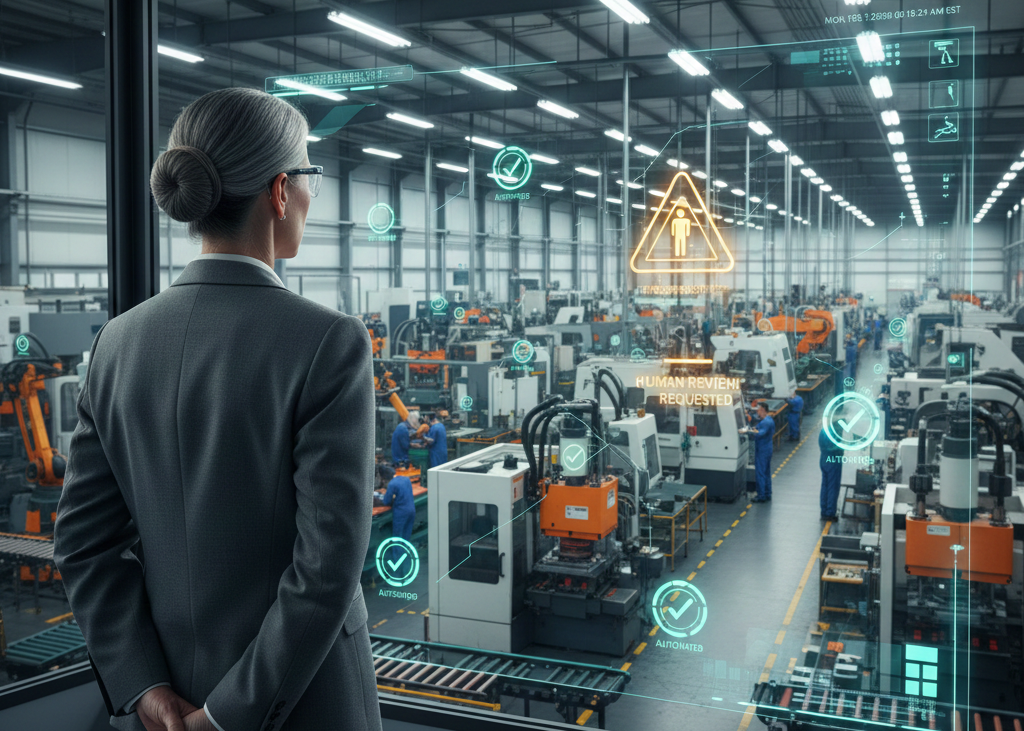
Agentic AI is moving quickly from experimentation to real use on factory floors. As manufacturers deploy copilots, AI-driven assistants, and early-stage agents, one challenge becomes clear: AI systems can reason about problems but lack a safe, standardized way to take action inside production environments.
This gap, where AI that can interpret signals but can’t operate reliably within OT/IT systems, is where Manufacturing MCP becomes essential.
Most manufacturing AI initiatives surface anomalies, trends, and predictions. But without a mechanism for connecting AI directly to tools, data, and workflows, humans still perform the orchestration. MCP creates a structured, permissioned action layer so AI can support execution within clear boundaries.
Traditional MES, ERP, and PLM architectures expect deterministic workflows and human operators. Large language models, however, operate probabilistically and require rich context to behave safely. MCP provides a buffer between these worlds—translating agent requests into controlled, predictable tool calls.
Every plant has unique integrations, custom scripts, siloed data flows, and one-off automation logic. Without standardization, AI becomes brittle and hard to govern. Manufacturing MCP defines consistent schemas, permission models, and validation rules so agents interact with systems the same way humans do—following role-based access and audit requirements.
Manufacturing MCP matters now because it gives AI a safe way to participate in operations without bypassing the controls, constraints, and accountability that production demands.
Manufacturing MCP is the application of Model Context Protocol—a growing AI integration standard—to the specific constraints of factory environments. It serves as a structured, AI-native interface layer that allows agents to understand context, request information, and take safe, governed actions.
Model Context Protocol (MCP) is a universal standard for connecting AI systems to tools and data sources. Instead of building custom integrations or brittle pipelines for every use case, MCP defines:
It functions as an AI-native analog to an API gateway—optimized for LLM reasoning, tool invocation, and safe execution.
In practice, MCP provides a clear contract for how an AI agent interacts with its environment:
MCP eliminates guesswork. Agents know exactly what actions they can take and how to take them.
To avoid misconceptions, it’s important to clarify what MCP does not do:
MCP is the interface, not the intelligence. Its purpose is to give AI systems a safe and structured way to interact with complex manufacturing environments.
Manufacturing is one of the most complex data environments in any industry. Systems are interconnected but rarely unified, and frontline work depends on real‑time information that spans machines, materials, people, and workflows. MCP introduces a standard that ties these elements together in a way that AI systems can safely and consistently consume.
AI systems cannot make reliable decisions without the full picture. On a factory floor, that picture includes:
Without structured domain context, AI agents hallucinate, choose incorrect steps, or misinterpret conditions. MCP provides the metadata and schema that ensure agents reason from accurate, contextualized information.
Most factories run a patchwork of technologies:
These environments are not designed for LLMs. They lack a clean, consistent way for AI systems to understand data structures, relationships, and identifiers.
MCP solves this by defining a single integration contract—vendors, tools, and agents all follow the same standardized method for exchanging information.
With MCP, teams gain:
In short: MCP gives manufacturing a stable, governed foundation for agentic behavior—one that meets the domain’s need for precision, predictability, and operational safety.
MCP is designed to give AI systems a structured, predictable way to interact with tools, data, and workflows. It breaks the integration problem into four elements—tools, context, permissions, and action pathways—each essential for safe agentic behavior in manufacturing.
Tools define what actions an AI system can take. Each tool describes:
Examples of tool capabilities in a manufacturing context include:
Tools give the agent its “hands”—the ability to take steps in the system.
Context defines how data is modeled and how systems relate to each other. It gives agents the information needed to reason correctly.
Manufacturing context often includes:
Without this context, AI systems misinterpret conditions or make assumptions that break safety and quality expectations.
MCP enforces permission boundaries through a principle of least-privilege intersection:
These controls ensure AI behaves no differently than a human user following role-based access rules.
Action pathways define how agents call tools using real parameters and how results are returned.
For manufacturing, strong pathways ensure:
Together, these four components—tools, context, permissions, and pathways—form the operational backbone that allows MCP to support agentic AI on the factory floor.
Generic MCP provides a broad pattern for connecting AI systems to tools and data sources. But manufacturing environments introduce additional constraints, safety expectations, and governance requirements that demand a more domain-aware implementation.
Manufacturing requires a level of determinism and auditability that generic MCP alone cannot provide:
These safeguards are essential when AI interacts with environments where mistakes create downtime, scrap, compliance issues, or safety risks.
Out-of-the-box MCP does not understand the unique context of OT/IT systems:
A manufacturing-specific MCP implementation provides richer metadata, operational constraints, and business logic so AI systems can behave predictably.
In short: Generic MCP defines how to integrate. Manufacturing MCP defines how to integrate safely in one of the most demanding environments for AI-driven action.
Manufacturing MCP is already proving useful in real operational scenarios. These examples illustrate how MCP enables AI systems to participate safely and effectively in frontline work while respecting existing constraints and governance.
Agents can compile structured daily summaries by:
MCP ensures agents only access data the user is permitted to view and that proposed actions stay within defined boundaries.
Agents can monitor stock conditions and propose replenishment actions.
Examples include:
This creates a closed-loop pathway from detection to proposed action, all governed by MCP’s permission and validation layers.
With MCP, agents can:
This simplifies setup processes and reduces manual configuration errors.
Agents can support quality engineers by:
All actions remain auditable, with human review built into the workflow.
Using MCP, agents can read app exports and:
This accelerates solution development while maintaining governance and quality standards.
MCP is the missing connective layer that allows agentic AI to move from insight to controlled execution on the factory floor. Without MCP, AI systems remain advisory—able to describe problems but unable to participate safely in workflows. With MCP, agents gain the structure and guardrails needed to take meaningful, governed action.
Agentic AI in manufacturing must operate with narrow, well-defined objectives. MCP provides the schema to scope those goals, ensuring agents:
This keeps autonomy predictable and aligned with production requirements.
MCP turns AI intent into safe, structured tool invocations. Each action follows:
This allows manufacturers to treat agent actions with the same rigor as automated workflows and human-initiated steps.
Manufacturing autonomy requires humans to remain accountable. MCP provides the scaffolding for:
As governance patterns mature, MCP lays the groundwork for agents to coordinate across domains such as maintenance, quality, and production planning.
This is not full autonomy—it's coordinated, bounded assistance built on top of a shared, validated context layer.
MCP closes the insight‑to‑action gap by giving agents a safe, reliable way to support real operational work.
MCP introduces powerful capabilities, but it also requires thoughtful implementation to ensure agents behave safely and consistently across manufacturing environments.
Manufacturing MCP must honor the same permission structures that govern human users. Key considerations include:
These models prevent privilege escalation and ensure accountability.
Manufacturers must be able to verify that MCP-driven actions behave consistently over time.
This enables MCP to pass the scrutiny of regulated processes and quality systems.
Agents must operate with clear limits. Manufacturing MCP should define:
These boundaries create predictable, safe behavior and reinforce trust in MCP-enabled automation.
Manufacturing MCP is the application of Model Context Protocol to factory environments. It provides a structured, permissioned interface that allows AI systems to access contextual data and trigger tools safely.
MCP enforces permission boundaries, governs tool invocation, and provides context-rich schemas. Agents inherit user permissions, all actions are logged, and high‑risk steps require human review.
Yes—but only within bounded, well-defined scopes. MCP ensures agents act predictably, adhere to governance rules, and escalate when uncertainty is high.
Traditional API gateways expose endpoints. MCP exposes capabilities designed for AI reasoning, including tool schemas, context, metadata, and permission models.
No. MCP is not a system of record. It provides a safe method for AI to interact with MES, ERP, PLM, QMS, and custom applications.
Only what’s defined in the tool and context schemas. Examples: machine states, app structures, operator data, inventory information, and quality records—filtered through user-level access.
MCP supports HITL/HOTL patterns by routing tool calls through approval steps, logging actions, and ensuring humans remain accountable for high‑impact decisions.
Manufacturers should:
Preparing these foundations ensures MCP can be deployed safely and scalably in production environments.